Methods & research
How HeartSight works
The short version
The back of your eye is the one place a doctor can look at your blood vessels directly, without surgery. Those vessels age along with the rest of your cardiovascular system, so a photo of them carries a surprising amount of information about your heart.
HeartSight takes one of those photos, a standard retinal scan that opticians already capture during routine eye exams, and estimates a heart age: how old your cardiovascular system looks, regardless of your actual age. If that number comes back higher than your real age, it can be an early hint that your vessels are ageing faster than they should, which is a known signal for heart-disease risk.
In other words: upload an eye photo, get back an estimate of your heart's age, a simple risk band, and a heatmap showing which parts of the image the model paid attention to. It is a fast, non-invasive, no-blood-draw way to flag people who might benefit from a closer look, not a diagnosis.
What happens under the hood
The photo is first cleaned up, cropped to the circular retina, contrast-enhanced, and resized so every image looks consistent to the model. A vision transformer (ViT-B/16) then reads the image and converts it into a list of 768 numbers that summarise what it sees in the vessels.
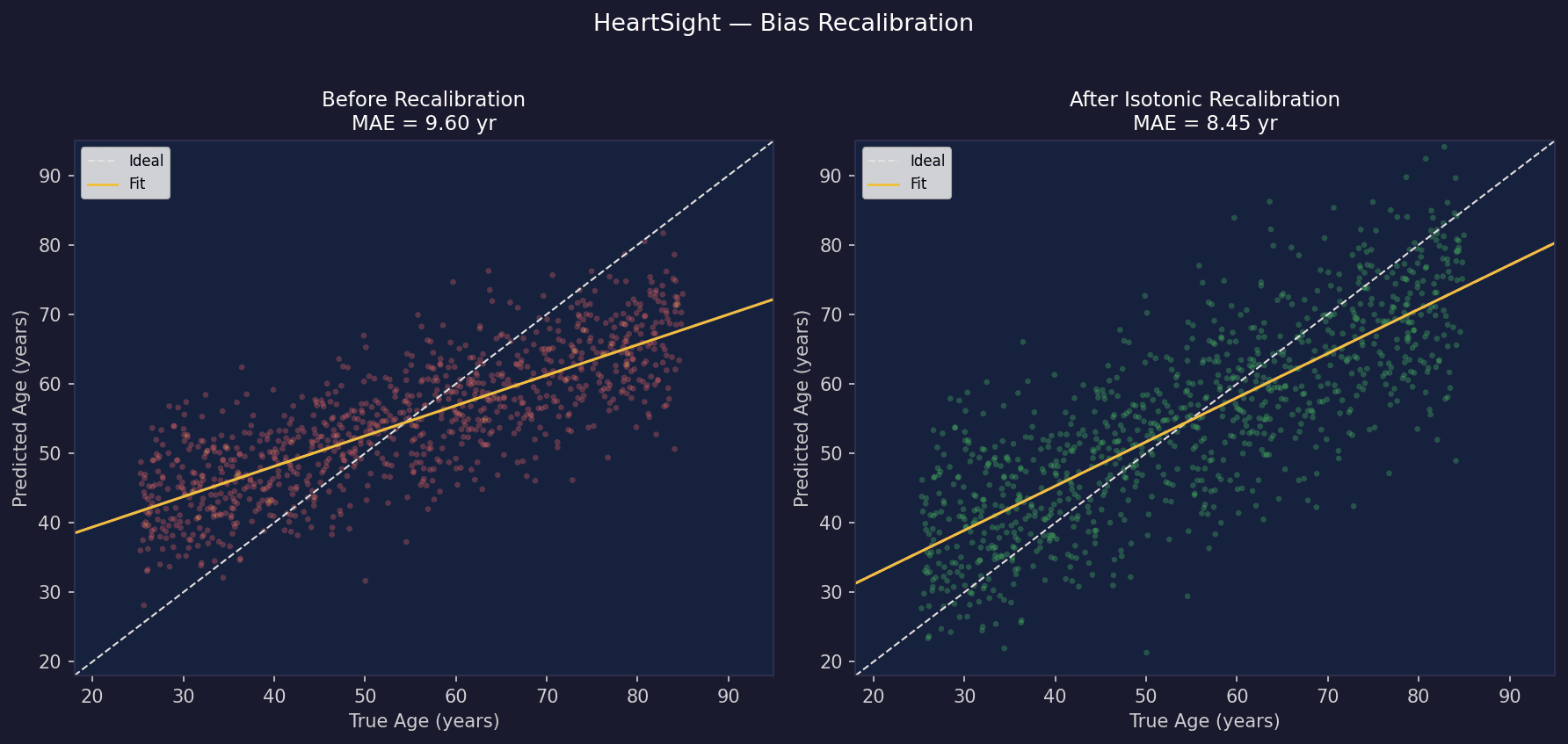
A simple regression model turns those numbers into an age estimate. Because models like this tend to play it safe, guessing everyone is close to average age, we add a recalibration step that stretches the predictions back out, so older patients are not quietly under-estimated. Finally, a saliency heatmap highlights the vessel regions that most influenced the prediction, so the result is not a total black box.
The age gap and risk
The key output is the age gap: predicted heart age minus real age. A positive gap means the vasculature looks older than expected, which published research links to higher cardiovascular and mortality risk. We translate it into three plain bands, a gap of 2 years or less is low, 2 to 5 years is moderate, and more than 5 years is high.
How well it works, honestly
On held-out test images from the ODIR-5K dataset, predictions land within about 4.7 years of the true age on average. That is a genuinely hard problem and the model is a weak-but-honest predictor: it captures the broad trend rather than nailing exact ages. On a completely different dataset shot with different cameras (APTOS 2019), the error grows to roughly 13 years, a reminder that these models do not yet transfer cleanly across populations and equipment.
Closing that gap is where stronger retina-specific backbones such as RETFound or DINOv2 come in; we could not load them in time for this demo, and a further BRSET evaluation is pending dataset access.
Recalibration, visualised
The plot below shows predictions before and after the recalibration step, the correction pulls the estimates back into line, especially for older patients who the raw model tends to under-age.
What this is not
HeartSight is a research demonstration, not a medical device. It does not diagnose disease and must not be used to make medical decisions. The training data skews toward one population, the age gap is a population-level signal rather than a personal verdict, and the saliency map shows a general vessel pattern rather than exact per-pixel reasoning. For any real health concern, talk to a licensed clinician.